
7 Tips for Buying Colorful Socks in Bulk for Global Buyers?

Time:2026-10-28 Author:Isabella
0%

Buying Colorful Socks in bulk can look simple until color, sizing, and delivery details collide. Global buyers need more than attractive product photos. They need a sourcing process that protects quality, margins, and customer trust.

This guide presents seven practical tips for selecting Colorful Socks from overseas suppliers. It considers material composition, knitting quality, colorfastness, size ranges, packaging, minimum order quantities, and shipping plans. A reliable buyer should request physical samples before confirming a large order. Check the toe seams by hand. Stretch the cuffs. Wash one pair and inspect fading, shrinkage, and shape recovery. Small tests often reveal expensive problems.

Supplier evidence matters. Review factory experience, product specifications, inspection procedures, and relevant certificates for the target market. Ask how colors are matched between production batches. A red sample may become darker under different lighting. That detail is easy to miss. It should not be. Buyers should also compare delivered cost, not only the unit price, because freight, duties, packaging, and delays affect the final margin. No checklist is perfect. Market preferences can change, and a popular pattern may perform poorly in another region. Thoughtful sourcing leaves room for feedback, corrections, and realistic contingency plans. With careful verification and clear communication, Colorful Socks orders can become more consistent, distinctive, and commercially dependable.
7 Tips for Buying Colorful Socks in Bulk for Global Buyers?

Define Your Target Market and Bulk Sock Requirements

Before buying colorful socks in bulk, define who will wear them and where they will be sold. A teenager’s preferred colors may differ from an office worker’s choices. Climate matters too. Lightweight cotton blends suit warm regions, while thicker styles fit colder markets. Review local sales data, customer reviews, and seasonal buying patterns before selecting colors.

Your bulk requirements should be specific. Record sizes, fiber content, color ratios, packaging units, and expected delivery dates. Ask for samples in every key color, not only one pair. Check color consistency, stitching, stretch recovery, and washing performance. In my experience, bright colors can look excellent under factory lighting but appear different in daylight. This detail is easy to miss.

Tips for global buyers: Build a simple demand forecast by size and color. Keep popular colors flexible, but avoid ordering too many unusual shades. Confirm labeling, material information, and packaging rules for each destination. These details support safer, more reliable purchasing. I once underestimated larger sizes, and the slow-moving stock affected the entire order. That mistake still matters. Leave room for returns, seasonal changes, and imperfect forecasts. Ask suppliers how they control dye lots and inspect finished cartons before shipment. A written specification prevents small misunderstandings from becoming expensive problems.

Choose Colors, Materials, Sizes, and Styles for Your Product Range

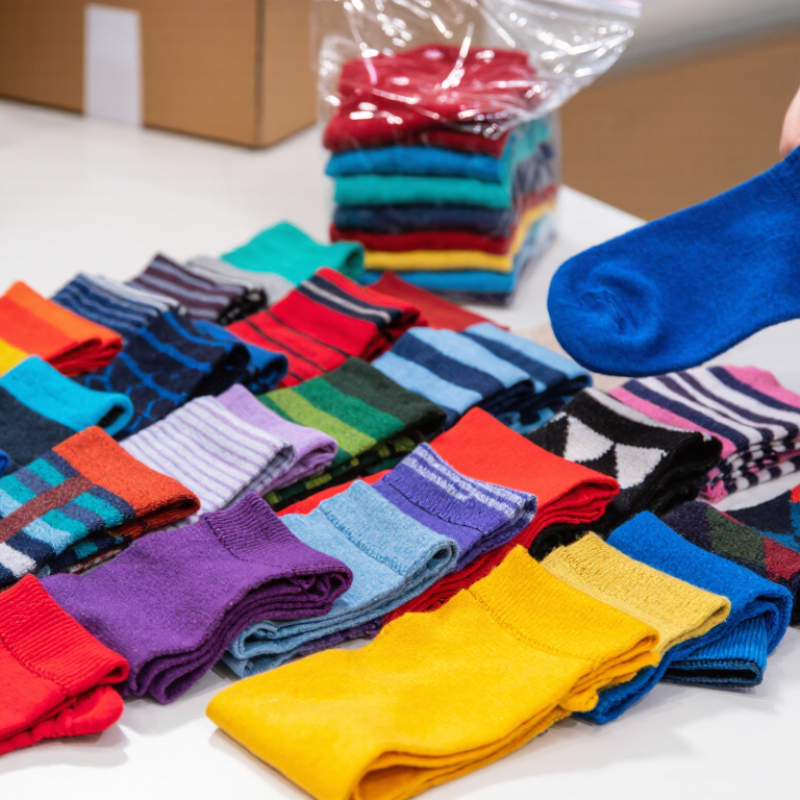
Color selection should follow local demand, not personal taste. Bright red, cobalt, and lime create strong visual impact on retail shelves. However, neutral colors often support repeat purchases and workplace use. In buyer trials, mixed packs performed better when one or two shades remained conservative. A practical range includes core colors, seasonal tones, and one experimental shade. Keep the ratio flexible.

Material choice affects comfort, durability, and environmental claims. Textile Exchange’s Materials Market Report 2024 states that global fiber production reached 124 million metric tons in 2023. Cotton offers softness and breathability, while recycled polyester improves strength and drying speed. Polyamide can support stretch and abrasion resistance. Ask suppliers for fiber percentages, colorfastness results, and testing records. “Sustainable” alone proves little.

Sizes must match each target market’s measurements. Do not assume one international size chart works everywhere. Request foot-length data from distributors, then build three or four practical size groups. Styles should reflect use: crew socks for everyday wear, ankle socks for sports, and cushioned versions for outdoor buyers. Fit matters. A 2024 global consumer survey by the International Textile Manufacturers Federation found that quality and durability remain major purchasing considerations across textile markets. Samples should be washed repeatedly before approval. My earlier mistake was judging softness after one wash. That was not enough. Check shrinkage, heel movement, toe seams, and color fading under real light.

Evaluate Suppliers, Customization Options, and Minimum Order Quantities

7 Tips for Buying Colorful Socks in Bulk for Global Buyers

Supplier evaluation should begin with production evidence, not polished photos. Request factory details, audit records, material specifications, and recent quality-control reports. Ask how suppliers check colorfastness, shrinkage, stitching, and size consistency. Small sample orders reveal more than promises. I once trusted a detailed catalog and missed uneven toe seams in the samples. That mistake was avoidable.

Compare at least three quotations using the same specifications. Confirm cotton content, yarn count, packaging, labeling, payment terms, and delivery schedules. Reliable suppliers explain their production capacity clearly. They should also identify testing standards relevant to your destination market. Keep communication in writing. Vague answers are warning signs. However, even careful buyers can overlook seasonal capacity limits.

Customization requires precise artwork and physical approval samples. Clarify color references, logo placement, woven labels, packaging designs, and permitted materials. Ask whether custom dyes require extra testing or longer lead times. Minimum order quantities often change by color, size, design, and packaging type. Negotiate a mixed-color order when possible, but confirm whether each variation has its own MOQ. A lower unit price may create excess inventory. That is not a saving. Review the size curve with real sales data, then reserve time for one pre-shipment inspection.

Check Quality Standards, Samples, Packaging, and Compliance

7 Tips for Buying Colorful Socks in Bulk for Global Buyers

Colorful socks look simple, but bulk purchasing requires disciplined quality checks. Confirm fiber content, yarn strength, dye stability, and stitching before discussing final prices. Ask for current test reports covering colorfastness, restricted substances, and skin-contact safety. Reports should match the actual material and production batch. Ask for proof. Small errors matter.

Request samples in every planned color and size. Wash them three times under normal conditions, then inspect fading, shrinkage, loose threads, and elastic recovery. Compare the toe seam with a ruler and record measurements. A sample may look excellent while the factory process remains inconsistent. This is where buyers often become too optimistic.

Packaging needs practical testing too. Check individual labels, carton strength, moisture protection, barcode readability, and packed dimensions. Overfilled cartons can crush socks and create costly warehouse problems. Confirm country-specific labeling, fiber declarations, care instructions, and required documentation before production. Compliance is not one universal checklist; destination markets differ. Keep approved samples, signed specifications, and inspection photos in one file. Do not rely only on verbal promises. Even experienced buyers miss details when colorways multiply. Recheck the final cartons before shipment.

Compare Costs, Shipping Terms, Lead Times, and Reordering Policies

Buying colorful socks in bulk requires more than comparing the unit price. Request quotes by carton, color mix, size ratio, and packaging method. A low factory price can disappear after labeling, inspection, customs, and inland delivery. The World Trade Organization forecast 2.7% merchandise trade growth for 2024, increasing pressure on reliable cross-border supply planning.

Tip: Compare landed costs, not factory costs. Ask whether quotations use FOB, CIF, or DDP terms. Confirm insurance, export documents, duties, and destination charges in writing. For example, a colorful sock order may need separate cartons to prevent dark dyes from marking light fabrics. This small detail can affect handling fees.

Tip: Measure lead times from payment approval to warehouse receipt. The World Bank’s Logistics Performance Index 2023 shows wide differences in customs efficiency and shipment timeliness between markets. Request production, inspection, and sailing dates separately. UNCTAD’s Review of Maritime Transport 2024 also highlighted disruption-related rerouting and longer shipping pressure. A promised 30-day delivery may become 45 days. It happens.

Tip: Study the reordering policy before approving samples. Confirm minimum reorder quantities, color replacement rules, and price validity. Ask whether the supplier reserves yarn or repeats dye lots. Repeated colors may still vary slightly. I would test one reorder before scaling, even when the first shipment looks perfect. A spreadsheet helps, but it cannot replace checking actual cartons, labels, and arrival condition.

7 Tips for Buying Colorful Socks in Bulk for Global Buyers: Compare Costs, Shipping Terms, Lead Times, and Reordering Policies

The figures below are practical, indicative benchmarks for standard knitted cotton-blend socks ordered in bulk during 2025–2026. Actual quotations vary according to fiber content, size range, artwork, packaging, testing, order volume, destination, and seasonal capacity.

Tip What to Compare Typical Bulk Benchmark Cost Consideration Shipping Terms Lead Time Reordering Policy
1. Define the product specification before requesting prices Fiber blend, sock height, size range, thickness, color count, logo method, packaging, and compliance requirements. Common commercial specifications include cotton/polyester or cotton/polyamide blends, 5–8 standard colors, and individual or multi-pair packaging. Changing yarn composition, adding sizes, or using custom packaging can increase the unit price by approximately 5%–25% compared with a standard specification. Request quotations on the same Incoterm, such as FOB, CIF, DAP, or DDP, so freight and import responsibilities are comparable. Specification confirmation and sample approval commonly take 3–10 business days. Ask whether the approved specification, color references, artwork, and packaging files will be retained for repeat orders.
2. Compare landed cost instead of unit price alone Product price, sampling fees, packaging, inspection, freight, insurance, duties, taxes, customs clearance, and local delivery. For standard bulk socks, indicative factory-level pricing is often about US$0.35–US$1.20 per pair before international freight, duties, and taxes. A lower unit price may be outweighed by small-order freight, destination charges, higher duty classification, or premium packaging. FOB usually excludes main international freight; CIF includes freight and insurance to the named port; DDP generally includes delivery, duties, and import taxes where legally available. Allow additional time for customs clearance and last-mile delivery when comparing delivered offers. Confirm whether repeat-order pricing is based on the original price, a new yarn quotation, or a mutually agreed price-adjustment formula.
3. Select the right shipping method for the order size Air freight, express courier, LCL sea freight, FCL sea freight, rail, or multimodal service. Sea freight is normally the most economical choice for palletized or container-volume orders; air freight is better suited to urgent replenishment. LCL can carry higher handling and destination fees per cubic meter; FCL may reduce unit logistics cost once the shipment is sufficiently large. Use the named place and version of the Incoterm, for example “FOB [port], Incoterms 2020,” and identify who pays origin and destination charges. Typical planning ranges are approximately 5–12 days for air, 25–45 days for ocean port-to-port service, plus customs and inland transport. For regular replenishment, compare scheduled consolidation services and reserve shipping capacity before peak seasons.
4. Check MOQ and the price breaks Minimum order quantity per color, size, design, and total order; price tiers; mixed-color rules; and sample-order limits. Standard designs may start around 500–1,000 pairs per color or design, while highly customized programs may require 2,000–5,000 or more pairs. Larger quantities can lower knitting, setup, packaging, and freight costs, but excess inventory increases storage and markdown risk. Ask whether the MOQ applies before or after carton consolidation and whether mixed colors can ship under one commercial invoice. Small mixed orders may take longer if production waits for a compatible production slot. Negotiate a lower MOQ for repeat orders when the yarn, knitting program, and packaging remain unchanged.
5. Allow for color approval and quality control Colorfastness, shade consistency, dimensional stability, stitching, elasticity, defects, labeling, and carton quantities. Use an approved physical swatch or recognized color reference, and define an acceptable tolerance for shade variation before production begins. Pre-shipment inspection commonly costs roughly US$200–US$500 per man-day, excluding travel or laboratory testing, depending on location and scope. Clarify whether inspection occurs at the factory before shipment and who pays for reinspection, rejected goods, rework, or replacement freight. Add approximately 2–5 business days for final inspection, corrective action, and release documentation. Require repeat orders to match the approved reference and specify how shade deviations will be handled.
6. Confirm production and delivery lead times in writing Sample time, material sourcing, knitting, dyeing, finishing, packaging, inspection, booking, and transit. A standard repeat order often requires about 20–45 calendar days for production after artwork and specifications are approved; custom programs may take longer. Rush production, special yarns, low-volume color runs, and split shipments may add surcharges or increase the total landed cost. Separate factory lead time from transit time and state the shipment date, port, booking responsibility, and documentation deadline. Plan for longer schedules around major holidays, peak retail seasons, port congestion, and customs inspections. Ask whether repeat orders receive priority capacity and what compensation or remedy applies if agreed milestones are missed.
7. Build a clear reordering and inventory plan Archived specifications, retained samples, color references, safety stock, reorder triggers, payment terms, and claims procedure. A practical reorder trigger is often one full production-and-shipping cycle before projected stockout, with extra buffer for seasonal demand. Holding approximately 4–8 weeks of additional demand can reduce stockout risk, but the ideal buffer depends on sales volatility and replenishment reliability. Agree on whether future orders ship under the same Incoterm and how freight-rate changes, duties, and exchange-rate movements are passed through. For established specifications, repeat production may be faster than the first order, but yarn availability and capacity should still be reconfirmed. Prefer written terms covering price validity, minimum reorder quantity, deposit requirements, color matching, defect claims, replacement timing, and discontinued-material notices.
Buyer checklist: Request a like-for-like quotation, confirm the Incoterm and destination charges, approve a physical color reference, separate production from transit lead time, verify MOQ by color and size, and document the repeat-order and claims process before placing the deposit.

FAQS

How should I define my target market before buying colorful socks in bulk?

Identify the users, selling locations, climate, and buying season. Teenagers may prefer vivid colors, while office workers often choose neutral shades. Review local sales data and customer feedback. Personal taste is not enough.

Which colors and materials work well for different markets?

Use bright red, cobalt, or lime for strong shelf visibility. Keep neutral shades for repeat purchases and workplace use. Cotton blends suit warm regions, while thicker materials fit colder areas. Recycled polyester can improve drying speed and strength.

What information should a bulk sock specification include?

Record sizes, fiber percentages, color ratios, packaging units, labels, and delivery dates. Include stitching, stretch recovery, shrinkage, and washing requirements. A written specification prevents small misunderstandings.

How many samples should I request before approving production?

Request samples in every important color and size. Test them under daylight, not only factory lighting. Wash each sample repeatedly. Check fading, toe seams, heel movement, shrinkage, and softness. One wash is not enough.

How can I choose suitable sizes for international customers?

Do not rely on one universal size chart. Request foot-length data from local distributors or sales records. Build three or four practical size groups. Larger sizes are easy to underestimate. That mistake can create slow-moving stock.

What should I check when comparing potential suppliers?

Request production details, material records, testing results, and recent quality-control reports. Compare at least three quotations using identical specifications. Ask how they control color lots and inspect finished cartons. Polished photos prove very little.

How do customization and minimum order quantities affect the purchase?

Confirm artwork, color references, label placement, packaging, and permitted materials. Ask whether each color or size has a separate minimum order. Mixed-color orders may reduce excess inventory. A lower unit price is not always a saving.

How can I reduce risks before shipment?

Confirm labeling, material information, packaging rules, payment terms, and delivery schedules. Keep important communication in writing. Reserve time for a pre-shipment inspection. Leave room for returns, seasonal changes, and imperfect forecasts. No forecast is perfect.

Conclusion

Buying Colorful Socks in bulk requires careful planning to ensure the products match your market and business goals. Start by identifying your target customers, preferred price range, seasonal demand, and expected order volume. Then define your product range by selecting suitable colors, materials, sizes, patterns, and styles. Consider whether you need everyday socks, athletic designs, children’s options, or customized products. When comparing suppliers, review their production experience, customization capabilities, minimum order quantities, and communication efficiency.

Before placing a large order, request samples to assess fabric quality, color accuracy, comfort, stitching, sizing, and durability. Confirm packaging requirements and verify that products meet applicable safety, labeling, and import standards. A complete cost comparison should include unit prices, customization fees, packaging, shipping terms, taxes, and other related expenses. Also evaluate production lead times, payment conditions, quality control procedures, and reordering policies. Choosing a reliable supplier with consistent standards and flexible cooperation can help you reduce risks, maintain product quality, and build a stable long-term supply plan.

Isabella

Isabella

Isabella is a dedicated marketing professional with a sharp focus on driving brand growth and engagement through strategic content creation. With an extensive background in digital marketing, she combines her passion for storytelling with her keen understanding of industry trends to deliver......